
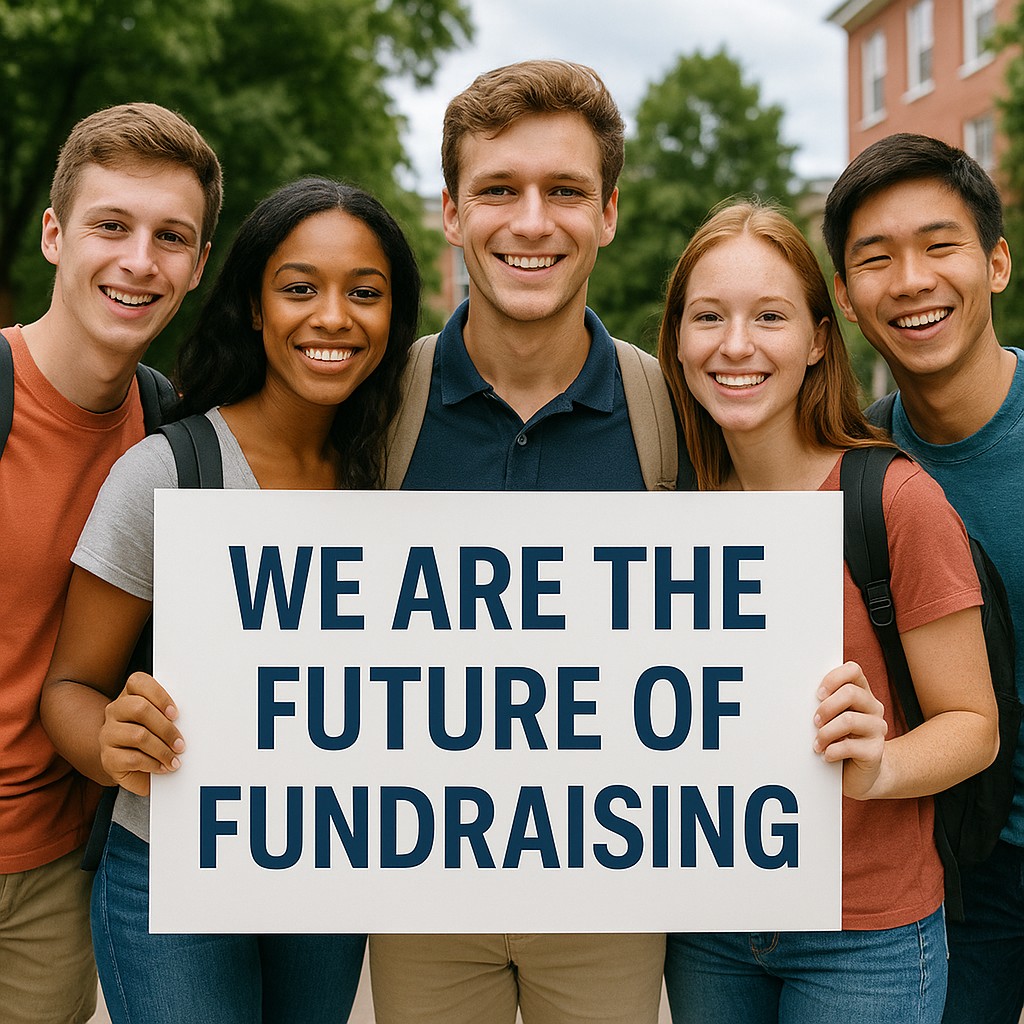
For years, boardrooms and advancement offices have spoken about young people as if they were an approaching weather system—something to prepare for someday, something on the horizon, something that will matter eventually. But that framing is already outdated.
Walk into any campus center, co-working space, or TikTok feed at two in the morning, and you’ll notice something extraordinary: young people are giving constantly. They are raising money for strangers. They are paying for each other’s medical bills. They are funding climate activists, creators, mutual aid efforts, and social justice campaigns with a speed and passion that would overwhelm most traditional fundraising offices.
The biggest misunderstanding in philanthropy today is that Gen Z is a “future donor segment.” They’re not.
They are building an entirely new philanthropic reality—right now, in real time—and the nonprofit sector is scrambling to keep up.

The Generation That Gives Differently—Not Less
There is a moment I keep returning to. A young donor—barely twenty-two—explained to me that he regularly sends $10 or $15 to people he’s never met because “impact shouldn’t require paperwork.” Another told me she prefers giving through livestream fundraisers because “you can see the money change someone’s life instantly.”
These aren’t exceptions. They’re signals.
Gen Z gives more than any generation did at their age.
But they give on their own terms—directly, transparently, emotionally, and often impulsively.
They do not give to institutions simply because those institutions have buildings or history. They give because the mission aligns with their identity, the impact is visible, and the relationship feels human rather than bureaucratic.
If your nonprofit moves too slowly, communicates like a corporation, hides its failures, or relies on prestige instead of authenticity, Gen Z won’t try to fix you.
They’ll simply move on.

A Power Shift in Donor Psychology
Older generations gave because they believed in organizational stability.
Gen Z gives because they believe in momentum.
They are the first generation raised inside a constant stream of information—stories, injustices, victories, and opportunities circulating globally at every hour of the day. They expect the same transparency and immediacy from the nonprofits they support.
If you don’t tell the story quickly, someone else will.
If you don’t show them the impact, they’ll assume there wasn’t any.
If you don’t speak to them in a real, unscripted human voice, they will close the tab before you finish your first sentence.
This isn’t impatience.
It’s literacy.
They’ve grown up with dashboards, receipts, instant feedback—and they expect philanthropy to operate at that same level.

AI: The Secret Language Young Donors Already Speak
When I talk to fundraisers about AI, some still speak about it cautiously, as though they’re discussing an unpredictable animal. But to young people, AI isn’t revolutionary—it’s normal. It’s embedded in their music algorithms, their shopping history, their sleep apps, and their creative tools.
So when a nonprofit uses AI to personalize communication, tailor a story, or deliver impact faster, Gen Z sees it not as intrusive but as intuitive.
When a nonprofit refuses to modernize, they don’t see it as protecting tradition—
they see it as falling behind.
Imagine an organization sending a young donor a personalized video update of the exact impact their $25 monthly gift made. Not a generic newsletter—an actual narrative built around their interests. Most nonprofits don’t even conceive of this level of personalization. To Gen Z, it simply feels like respect.

Where Most Organizations Are Losing Them
There’s a painful truth I wish wasn’t so common:
many nonprofits talk about young donors, but very few actually talk to them.
Young donors leave because:
- the organization takes too long to follow up,
- the thank-you feels automated or generic,
- the impact report is buried behind a PDF download,
- the brand voice feels polished but emotionless,
- or communications feel like they were written for someone twice their age.
Gen Z can detect inauthenticity faster than any generation before them.
They don’t expect perfection—but they expect honesty, imperfection, personality, and speed.
If your institution cannot tell its story in under fifteen seconds—visually, clearly, emotionally—you’re losing them before you even begin.
What the Sector Must Learn to Do Differently
I worked recently with a group of young professionals who donated modestly but consistently to a local cause. When asked why they stayed engaged when so many peers drifted away, one of them said, “Because they talk to us like we matter—even though we’re not wealthy yet.”
That line stuck with me. Even though we’re not wealthy yet.
Many young donors don’t feel seen because the nonprofit world still treats them as “the donors of tomorrow.” But Gen Z is making philanthropy happen everywhere they go. They’re giving, sharing, boosting, influencing, and organizing at a scale no development office could engineer manually.
Organizations that invest in these relationships now—with authenticity, agility, and modern tools—will be the ones cultivating the next generation of major donors.
And those that wait?
They’ll wake up one day to find their pipeline empty and wonder when the future slipped away.

The Heart of the Matter
The story of Gen Z in philanthropy is not a story of youth.
It is a story of urgency, alignment, creativity, and radical generosity.
They are not waiting for permission to reshape the world.
They are doing it with or without institutional support.
Fundraisers who understand this moment—and who embrace AI, storytelling, transparency, and rapid engagement—will find that young donors are not only willing to give; they are eager to build, advocate, volunteer, and dream alongside you.
But you only earn their loyalty if you meet them where they are, not where you wish they were.
In the end, the question isn’t whether Gen Z will change philanthropy.
They already have.
The question is whether we—fundraisers, nonprofits, institutions—will evolve fast enough to meet the world they are creating.


Leave a Reply